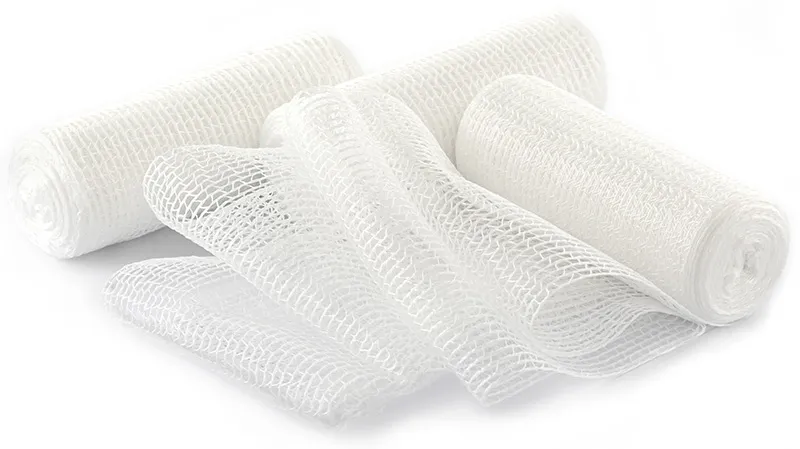
Knitted hydrophilic non-sterile bandages are intended mainly for fixation of injuries within first aid. They are produced from various materials, most frequently a blend of cotton and viscose, which imparts the bandage softness, absorbency, and air permeability.
Fixation bandages in the material combination of viscose yarn with textured polyester distinguish themselves with excellent absorbency, they are softer and gentler to the skin and their slight elasticity guarantees good adherence of the bandage and easy fixation of auxiliary treatment aids.
The bandages in small widths of 3 cm x 5 m and 4 cm x 5 m are ideal for fixing hands and fingers and for bandaging of lymphatic swelling. When bandaging hands and fingers, they do not need to be folded over and no bruising occurs.
Highly absorbent 100% cotton
Cotton/viscose blend (the most common combination) 100% viscose
100% PES
Viscose/PES blend
| Length (streched, m) | Width (cm) |
| 4 | 6 / 8 / 10 / 12 / 14 / 16 |
| 5 | 1 / 2 / 3 / 4 / 6 / 8 / 10 / 12 / 14 / 16 / 20 |
| 10 | 8 / 10 / 12 / 14 / 16 / 20 |
Different sizes according to customer‘s wish.
The bandages are used as tamponade bandages in widths of 1, 2, 3 and 4 cm
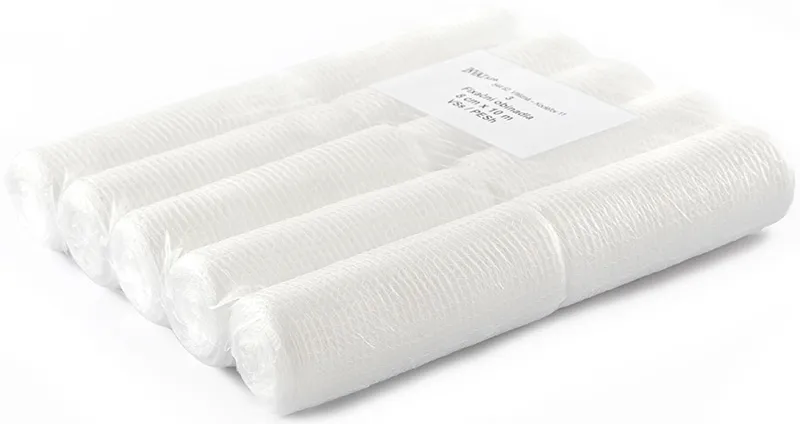
Bandages packed per 10 pieces (50 and 100 pieces in case of small widths) in PE bags are delivered in cardboard boxes of 45 x 45 x 45 cm.
Viscose/PES blend (the same dimensions and packaging for 100% viscose, 100% cotton and 100% PES)
| Width (cm) | Length (m) | Number of pieces in package | Number of pieces in a box |
| 6 | 4 | 10 | 900 |
| 8 | 4 | 10 | 650 |
| 10 | 4 | 10 | 600 |
| 12 | 4 | 10 | 500 |
| 14 | 4 | 10 | 400 |
| 16 | 4 | 10 | 400 |
| 1 | 5 | 100 | as required |
| 2 | 5 | 50 | as required |
| 3 | 5 | 50 | as required |
| 4 | 5 | 10 | as required |
| 6 | 5 | 10 | 900 |
| 8 | 5 | 10 | 650 |
| 10 | 5 | 10 | 600 |
| 12 | 5 | 10 | 500 |
| 14 | 5 | 10 | 400 |
| 16 | 5 | 10 | 400 |
| 20 | 5 | 10 | 350 |
| 8 | 10 | 10 | 370 |
| 10 | 10 | 10 | 300 |
| 12 | 10 | 10 | 250 |
| 14 | 10 | 10 | 200 |
| 16 | 10 | 10 | 180 |
| 20 | 10 | 10 | 160 |
Cotton/viscose blend
| Width (cm) | Length (m) | Number of pieces in package | Number of pieces in a box |
| 6 | 4 | 10 | 900 |
| 8 | 4 | 10 | 650 |
| 10 | 4 | 10 | 600 |
| 12 | 4 | 10 | 500 |
| 14 | 4 | 10 | 400 |
| 6 | 5 | 10 | 900 |
| 8 | 5 | 10 | 650 |
| 10 | 5 | 10 | 600 |
| 12 | 5 | 10 | 500 |
| 14 | 5 | 10 | 400 |
| 8 | 10 | 10 | 370 |
| 10 | 10 | 10 | 300 |
| 12 | 10 | 10 | 250 |
| 14 | 10 | 10 | 200 |
| 16 | 10 | 10 | 180 |
| 20 | 10 | 10 | 160 |
Risk class I
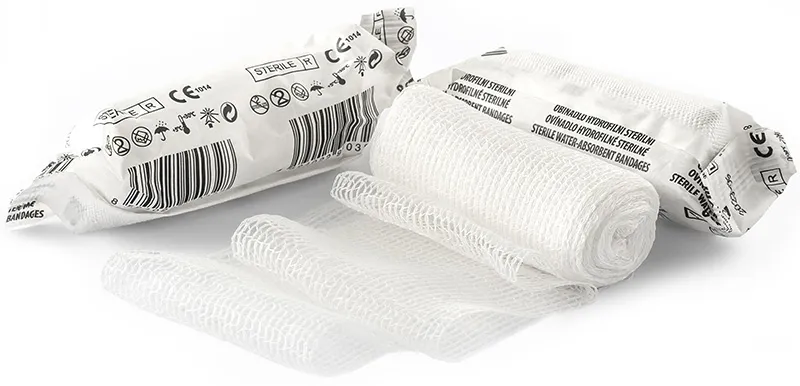
Knitted hydrophilic sterile bandages are intended for bandage of wounds that have already been covered with a compress or otherwise and thus they serve for fixation of these initial items. At the same time, they can also be used directly to cover wounds within first aid (especially when used at home).
Highly absorbent 100% cotton
100% viscose
Cotton/viscose blend
Viscose/PES blend
| Length (streched, m) | Width (cm) |
| 5 | 6 / 8 / 10 / 12 |
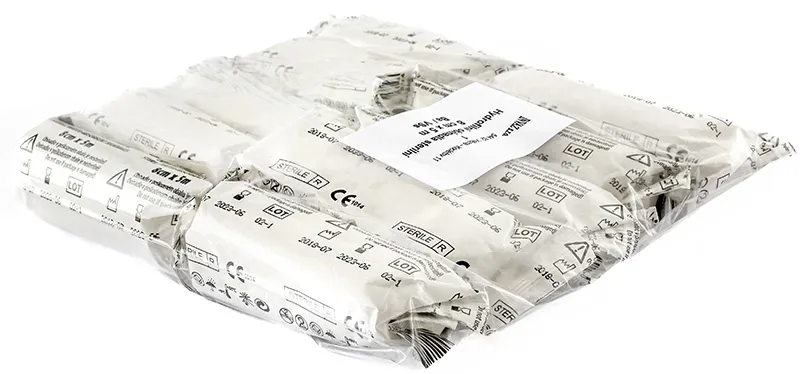
Individually packed bandages are delivered in cardboard boxes of 50 x 50 x 50 cm.
Cotton/viscose blend (the same dimensions and packaging for viscose/PES, 100% viscose and 100% cotton)
| Width (cm) | Length (m) | Number of pieces in package | Number of pieces ina box |
| 6 | 5 | 1 | 800 |
| 8 | 5 | 1 | 600 |
| 10 | 5 | 1 | 500 |
| 12 | 5 | 1 | 500 |
Risk class Is
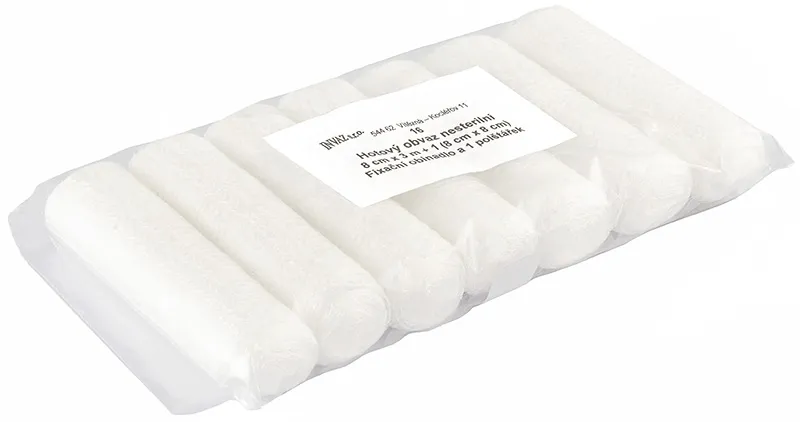
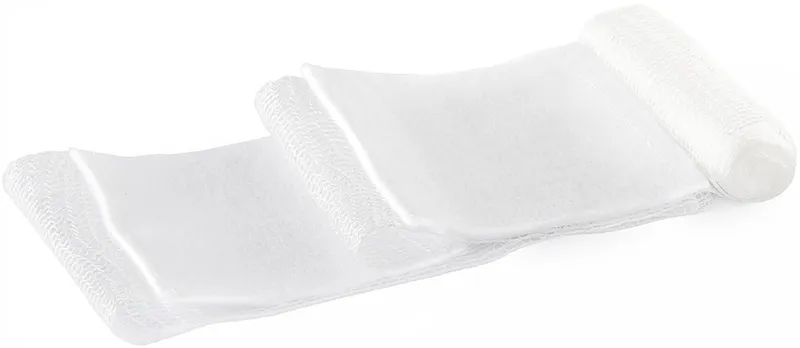
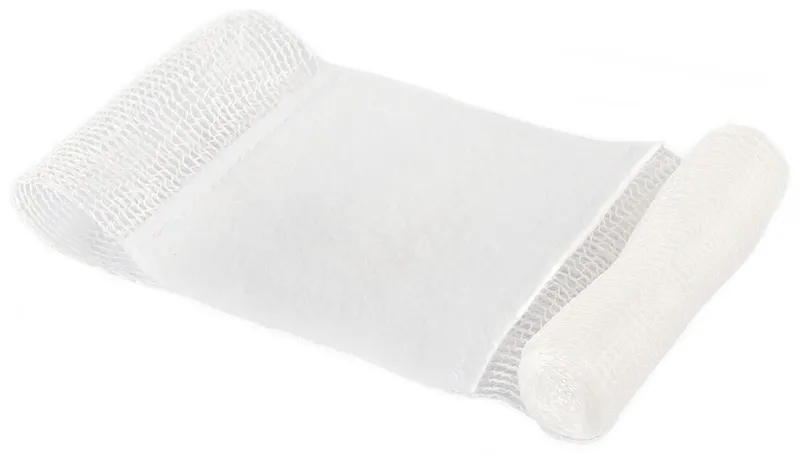
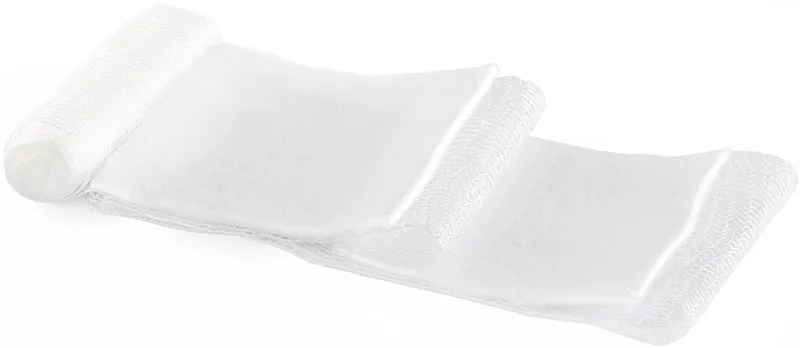
A non-sterile dressing is composed of two components – a fixation bandage and an absorbent pad, which allows to take up significant quantity of fluid, it covers the wound very well and creates a microclimate.
It is used for treating wounds within first aid after an injury and is suitable for using in first aid kits in cars. The dressing can be rolled or folded and is fitted with one or two pads.
Fixation bandage is made of combination of viscose and polyester.
The pad is made of polyester nonwoven textile. The product can be fitted with various fixing clips or a Velcro fastener according to customer requirements.
| Length (streched, m) | Width (cm) |
| 3 | 8 (one or two pads) |
| 4 | 8 (one or two pads) |
Individually packed dressings are delivered in cardboard boxes of 40 x 40 x 40 cm or according to customer‘s request.
Risk class I
A sterile dressing is composed of two components – a fixation bandage and an absorbent pad, which allows to take up significant quantity of fluid, it covers the wound very well and creates a microclimate.
It is used as a top covering in dermatology, to cover wounds in surgery and to treat wounds within first aid after an injury. The dressing can be rolled or folded and is fitted with one or two pads of non-woven textile with a minimum absorbency greater than 800 g/m2 (but usually with absorbency of around 1,500 g/m2).
Fixation bandage is made of combination of viscose and polyester.
The pad is made of polyester non-woven textile. The product can be fitted with various fixing clips or a Velcro fastener according to customer requirements.
| Length (streched, m) | Width (cm) |
| 3 | 8 (one or two pads 8 x 8 cm) |
Individually packed dressings are delivered in cardboard boxes of 45 x 45 x 45 cm.
Risk class Is
In order to provide the best possible service, we use technologies such as cookies to store and/or access device information. Consenting to these technologies will allow us to process data such as browsing behavior or a unique ID on this website. Disagreeing or withdrawing consent may adversely affect certain features and functions.